
Burn injuries can range from minor to life-threatening. For EMS clinicians, the ability to quickly assess burn severity in the field directly influences airway management, fluid resuscitation, destination decisions, and overall patient outcomes.
A strong burn assessment focuses on three core factors:
Understanding these elements allows EMS providers to recognize serious burns early and initiate the right treatment pathway.
Burn depth helps determine how much tissue damage has occurred and how aggressively the patient may need to be managed.
Superficial burns affect only the outer skin layer, called the epidermis. These burns appear red and dry, similar to a mild sunburn. They blanch with pressure and typically do not blister. While painful, superficial burns usually heal without advanced medical treatment and do not count toward TBSA calculations used in severe burn management.
Partial-thickness burns extend into the dermis. These burns often appear red, moist, and blistered. They tend to be extremely painful because nerve endings remain intact. Partial-thickness burns do count toward TBSA when determining burn severity.
Full-thickness burns extend through the dermis and into deeper tissues. These burns may look white, brown, or charred. The skin often appears dry, leathery, and firm. Because nerve endings are destroyed, these burns may be less painful than partial-thickness injuries.
Recognizing these patterns allows EMS providers to estimate the seriousness of the injury even before advanced diagnostics are available.
Once you identify burn depth, the next step is to estimate the amount of skin involved.
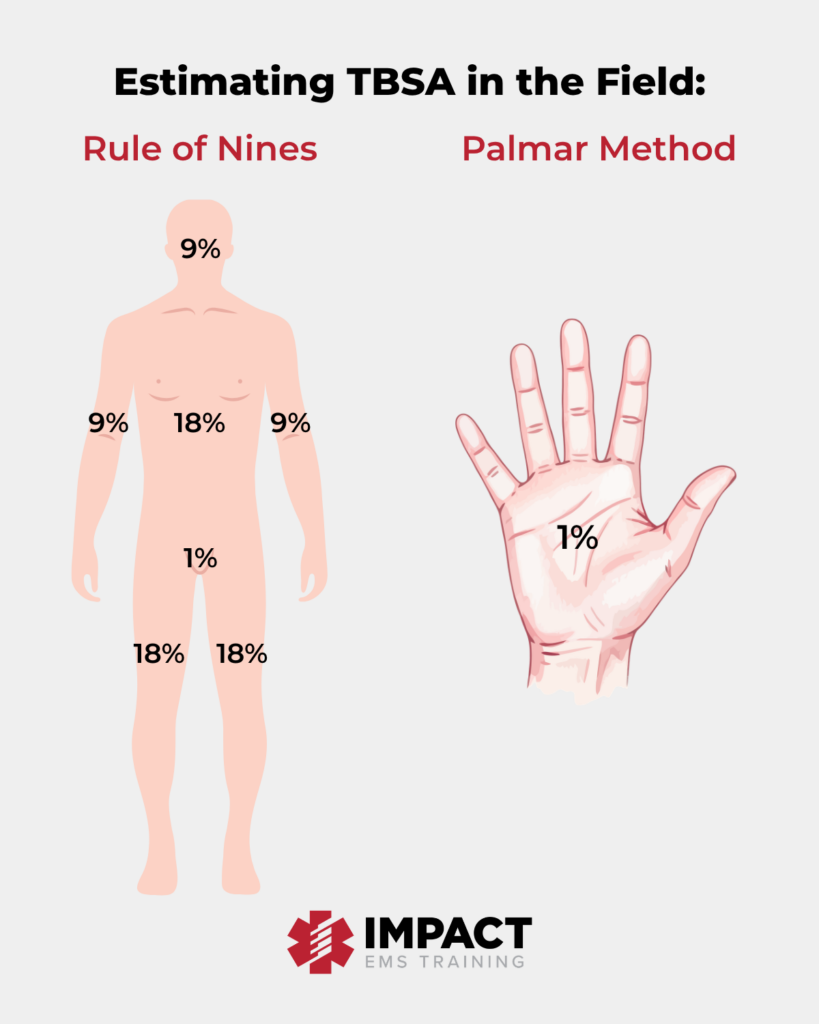
In adults, EMS providers often use the Rule of Nines to estimate TBSA in the field. This method divides the body into regions that represent roughly nine percent of the body’s surface area.
For example:
For smaller burns, the Palmar Method can help. The patient’s palm, including the fingers, represent roughly 1 percent of TBSA.
Only partial-thickness and full-thickness burns count towards TBSA calculations for severe burns. Superficial burns are excluded.
Burns involving more than about 20 percent TBSA significantly increase the risk of systemic inflammation, fluid shifts, and burn shock. That threshold often marks the transition from a localized injury to a systemic emergency.
Burn severity is not limited to visible skin damage. Airway injury can rapidly complicate burn cases, especially in enclosed-space fires.
EMS providers should suspect inhalation injury when patients show:
These signs should raise concern for airway swelling or carbon monoxide exposure. Early airway management may be necessary before swelling progresses.
Certain burns require rapid consultation with or transport to a burn center regardless of size.
These include burns involving:
Other high-risk burns include:
These injuries carry higher risks of complications, functional impairment, and long-term disability.
In the prehospital setting, you should treat burn patients using the same structured approach you use for trauma patients.
A practical sequence includes:
Burn severity assessment does not require advanced technology. It requires careful observation, structured evaluation, and clinical judgment.
For EMS providers, mastering these fundamentals ensures burn patients receive the right care at the right time, starting from the moment the crew arrives on scene.